


July 09, 2026
Primary care is the foundation upon which a high-value healthcare experience unfolds for individuals and populations. It is also one of the areas where employers may have the most direct impact on healthcare cost and quality, through thoughtful partnerships and program designs.
Against the backdrop of extraordinarily and persistently high healthcare trend in the U.S. and mindful of primary care access challenges, employers are once again focused on creating strong primary care fundamentals for their members, with quality primary care broadly seen as key to sustainably improved health outcomes and the hub for preventive care efforts.
Employers’ options for creating meaningful access to high quality primary care have been expanding, with the industry embracing both value-based care design principles and direct contracting models. In addition, onsite clinic providers have been expanding the scope of services to include primary care and, in the alternative plan design space, primary-care first offerings are one of the plan design options employers can consider.
With that progress in mind, further innovation and investment in primary care is also needed, as patient needs are becoming increasingly complex and provider shortage crisis looming. For primary care to be an effective bedrock of health experience and an engine that drives cost mitigation, we believe it must be advanced, accessible, affordable and accountable. The following section explains each feature in more detail.
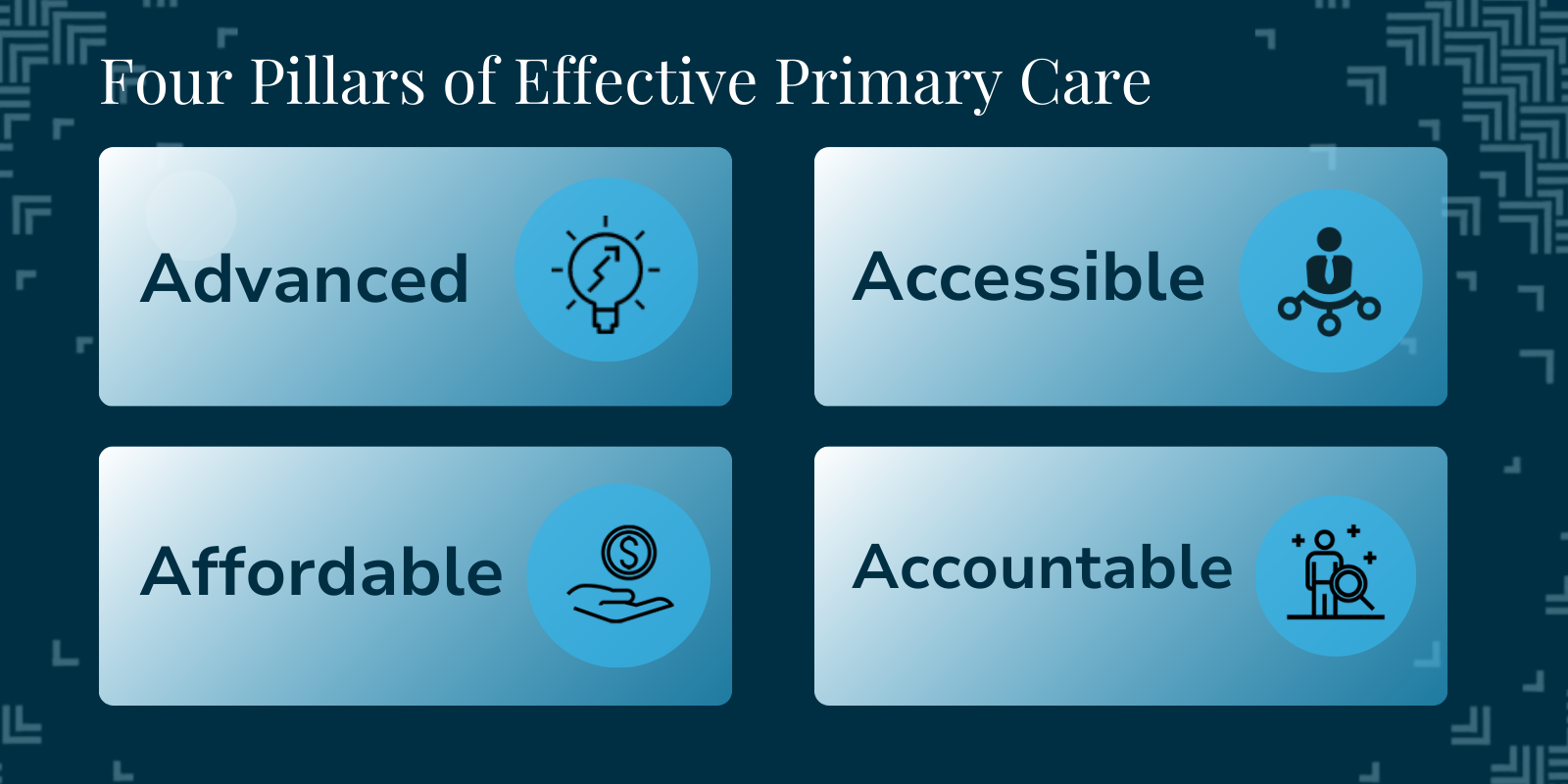
Advanced Primary Care Must Enable Innovation
Given the broad array of patient needs and resource constraints, primary care should aim for broad and swift adoption of innovations that can augment experience and care effectiveness. At the same time, innovators influencing other aspects of the healthcare system must ensure their efforts augment rather than complicate access to high quality primary care.
Many definitions of advanced primary care have been proposed, including from Business Group on Health. Common characteristics include 24/7 access to care whether in-person or virtual, proactive outreach to engage patients in prevention, multidisciplinary care teams and data that can enable quality referrals.
There is real progress being made toward modernizing primary care experience and access. Virtual primary care modalities are becoming a norm. AI augmented technology is increasing the capacity of primary care teams, with demonstrated improvements in patient outreach, care coordination and patient experience in the exam room. PCP practices powered by such innovation in the exam room and in the back office can become true patient’s “home” for healthcare, without becoming a disruptive “gatekeeper”.
Globally, a key consideration, especially across countries with different levels of health system maturity, is that advanced primary care must be effectively integrated with other elements of the healthcare experience, so that innovations can gain traction and scale in ways appropriate to local context, resources, and system capacity. Advanced primary care must be an augmenter and facilitator of the patient experience across the healthcare system by facilitating a connection to clinical virtual programs available to the patient.
Capitalizing on the opportunity to create advanced, innovative primary care experience demands timely and secure data sharing that does not restrict patients’ access to their information. Employers and their partners need to make sure that advanced primary care providers are equipped with the information they need to drive appropriate utilization of care. Data and technology can enable innovative approaches to primary care; value-based payment models can incentivize it.
Many are concerned that primary care providers are expected to solve problems beyond their traditional scope that they may be unequipped to handle, including being the first line of defense in the mental health crisis. On the one hand, expectations should be reasonable and properly supported, but on the other hand, the primary care system needs to advance its capabilities to address patient needs as they evolve. Primary care providers must be willing to embrace new technologies and care delivery models so they can increase their impact on a broader set of conditions in a sustainable manner.
Primary Care Can’t be a Bedrock if Patients Can’t Access it
People should be able to meaningfully access primary care services in multiple modalities when needing care, delivered by providers that can meet their diverse needs across different health system contexts. Despite many massive competing priorities, employers and their partners need to spend time, attention and resources on improving access to high-quality primary care, including access to both virtual and in-person care in ways that reflect local infrastructure and cultural expectations Achieving this goal may entail choosing direct contracting with primary care providers accountable for quality and access, encompassing those offering on-site and near-site clinic resources where such models are feasible within the countries’ regulatory and delivery environment or working through locally appropriate alternatives such as virtual first models, partnerships with community providers, or local pharmacies.
Primary care is a layered system rather than a single point of delivery, in which pharmacists and retail clinics can play a critical role in expanding access and addressing scheduling concerns. Across many regions, pharmacists serve as one of the most accessible entry points to care, supporting prevention, medication, vaccinations, basic screenings, and early triage, often without any appointment barriers. However, that simplified access may lead to “healthy” patients further disconnecting form the traditional PCP model at the time of rising health risks for increasingly younger populations. Employers rethinking the primary care strategy should actively seek to identify patient populations that have preferred the on-demand use of retail, pharmacy and urgent care and help steer them into a comprehensive, trusted, but accessible primary care model.
Globally, access to primary care varies significantly based on a host of factors by country and region, including public health infrastructure, workforce shortages, practitioners’ burnout, funding models and others. Many governments see primary care as a core component of the public health domain. At the same time, many employers are looking to expand access to primary care services themselves through on-site clinics or near site clinics, support for virtual care models, expansions in coverage for preventive services in private insurance plans and other approaches. Employers should seek opportunities to expand access to primary care in areas across the globe where services are underutilized and broad access is a challenge.
Primary Care Is ’Inexpensive’ Compared to Other Care, but that Doesn’t Mean It’s Affordable
Primary care is not considered a key cost driver; individual care episodes are not costly but the volume of such services results in primary care being a significant share of employer budgets. For patients, especially those in high-deductible plans, the cost and the surprise element can still be a significant access barrier. Lost time at work can also add to affordability concerns for many workers, especially hourly workers. Employers can directly address financial challenges limiting patient access to primary care. For example, some employers have reduced or eliminated out-of-pocket costs for all primary care visits or specifically those delivered in on-site clinics. Many offered virtual care with reduced or even no patient cost sharing.
Providers must embrace technologies and willingness to coordinate with other parts of the healthcare system to increase efficiencies and lower costs. Health plans need to build networks with a robust primary care infrastructure and elevate efficient high-quality primary care providers in their directories or referral pathways so patients can find affordable care more easily across different health system contexts.
With Increased Financial Support Must Come Accountability
The fee-for-service reimbursement model for primary care does not work well for healthcare providers, patients, or employers. Employers and patients are paying for primary care visits that are too short, too infrequent and not tied to the outcomes of care at all, where such payment models are used.
Employers need to promote and adopt value-based approaches in primary care. There are many reimbursement models that do a better job than FFS of holding providers accountable for their patients’ health outcomes, experience with care, accessibility, and quality scores. Money thoughtfully allocated to improving primary care access and quality is money well spent. Research suggests that up to 90% of healthcare cost is impacted by primary care; effective management of “big ticket cost items” like specialty drugs and hospital care will be significantly impacted by a patient’s primary care experience.i
Value-based approaches also have the potential to give high-performing primary care providers (and their clinical teams) a more stable, robust financial model that enables them to fund many services, such as virtual care, technologies adoption and data capabilities required for modern practice.
Data is a key factor in accountability. Providers and vendors must be willing to share data to enable effective care coordination between primary and specialty care providers across different health system contexts (including point solutions and other programs employers offer). A primary care practice armed with good data can increase accessibility, enabling longitudinal relationships between the practice and its patients and broader accountability for outcomes.
Conclusion
Primary care is one of the main areas where employers can have a direct impact on cost, access and employees’ healthcare experience. From prevention to specialist referrals and chronic condition management, effective primary care providers, empowered by aligned financial incentives, actionable data and newer technologies, can be the core of an effective health and well-being strategy. Prioritizing access and affordability of advanced primary care, while holding providers and health plans accountable for results, should be one of the top priorities of employers looking to achieve better health at a lower cost for their population.
i. Golden W et al. Changing how we pay for primary care. New England Journal of Medicine Catalyst. November 20, 2017. https://catalyst.nejm.org/doi/full/10.1056/CAT.17.0326. Accessed July 9, 2026.
Related Resources
- Value-based Primary Care
- What's Needed in Primary Care: Innovation With Integration
- Business Group on Health Calls for Congressional Action on Primary Care Legislation
- Business Group on Health Recommends 7 Action Steps To Speed Health Care Industry’s Move to Value-Based Payment Models
- Business Group on Health Submits Statement on Alternative Coverage Models and Arrangements
- Promoting Competition and Innovation in Health Care Policy Position Statement
- Taking Action on Value: A Business Group on Health Viewpoint
- Taking Action on Health Care Costs: A Business Group on Health Viewpoint
More Topics
Resource
 Primary Care
Value-based Care
Preventive Care
Primary Care
Value-based Care
Preventive Care
- 1 | Business Group on Health. 2025 Employer Health Care Strategy Survey. August 2024. https://www.businessgrouphealth.org/resources/2025-Employer-Health-Care-Strategy-Survey-Intro. Accessed April 28, 2025.
- 2 | Business Group on Health. 2024 Large Employer Health Care Strategy Survey. August 2023. https://www.businessgrouphealth.org/resources/2024-large-employer-health-care-strategy-survey-intro. Accessed April 28, 2025.
- 3 | Golden W et al. Changing how we pay for primary care. New England Journal of Medicine Catalyst. November 20, 2017. https://catalyst.nejm.org/doi/full/10.1056/CAT.17.0326. Accessed November 8, 2022.