


December 19, 2025

Supporting workforce mental health continues to be a priority for employers as employees and their families experience myriad challenges impacting their emotional well-being. Mental health conditions ranked as a top five cost driver among respondents in Business Group on Health's 2026 Employer Health Care Strategy Survey.1 This environment underscores the imperative for a cohesive and comprehensive strategy - one that assists every employee, from those who are thriving to those with mental health conditions and substance use disorders and everyone in between, and that prioritizes value.
A comprehensive mental health strategy is good for employees and for business. Extensive research documents the significant challenges related to poor mental health. According to a Milliman study of commercially insured adults in the U.S., claims for those with mental health conditions cost twice as much as those for individuals without them.2,3
Worldwide, depression is the leading cause of poor health and disability according to the World Economic Forum.4 And employees experiencing stress are more likely to miss work, become disengaged and leave jobs.5,6 What’s more, life expectancy is either stagnating or declining depending on the country, which is in part attributed to “deaths of despair”—overdoses, suicides and alcohol-related liver disease.7 Thus, there’s a burning platform to prevent and treat mental health and substance use disorders, and there are many opportunities for employers to make a positive impact on both business outcomes and employees’ lives through the development of a cohesive mental health strategy that attends to the spectrum of employee needs and focuses on value.
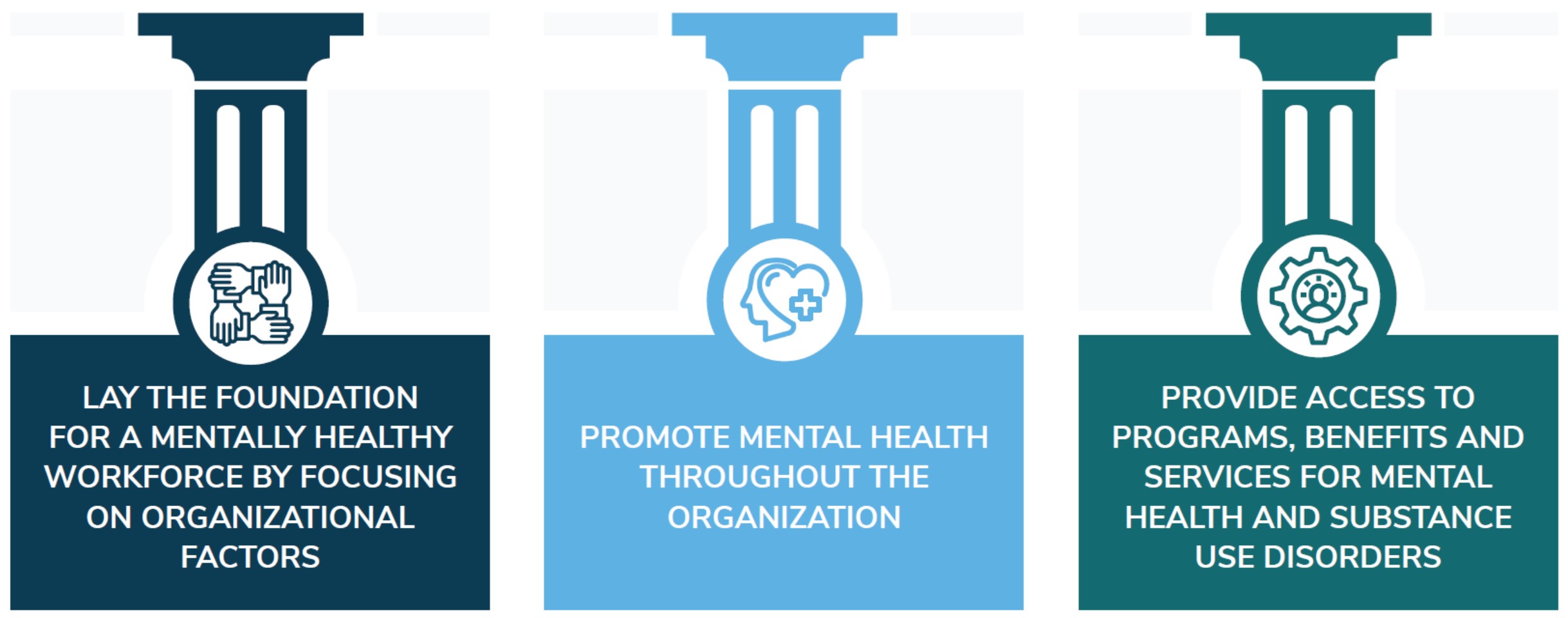
There is growing agreement among major health- focused entities, including the World Health Organization (WHO), the U.S. Surgeon General’s Office and leading voices in mental health, that creating a comprehensive strategy must involve assessing and addressing multiple factors, or “pillars,” in concert to best support workforce mental health.3,8,9 While different organizations may use their own terminology, these pillars typically include:
- 1 | Organizational factors that impact employee mental health;
- 2 | Initiatives to promote mental health; and
- 3 | Benefits and programs to treat mental health conditions and substance use disorders.
This Business Group resource is for employers – those in executive leadership roles, as well as those responsible for health benefits and employee well-being, and their health industry partners. The resource informs the development and execution of a mental health strategy built on the three pillars above. It covers:
- An in-depth review of the three pillars, including the benefits of focusing on each;
- The role that benefits and well-being leaders have in advancing each pillar, including actionable solutions for implementation; and
- Areas of opportunity for measurement, integration and accountability within and across each of the three pillars.
A Note on Terminology
There is varying terminology used to refer to mental health, including behavioral health, brain health, mind health, emotional health, mental fitness, etc. This resource uses the words: “mental health” “mental health conditions” and “substance use disorders.” Mental health may be more recognizable than other terms, as it’s more commonly used by organizations around the world and is intended to refer to a continuum, from thriving to crisis. Naming substance use disorders separately is intentional and seeks to ensure they are part of the conversation when creating a comprehensive mental health strategy.
-
IntroductionEngineering Mental Health: Building a Strategy from the Ground Up

-
Executive SummaryEngineering Mental Health: Executive Summary
-
Full GuideEngineering Mental Health: Full Guide
-
Pillar 1Pillar 1: Lay the Foundation for a Mentally Healthy Workforce by Focusing on Organizational Factors
-
Pillar 2Pillar 2: Promote Mental Health Throughout the Organization
-
Pillar 3Pillar 3: Provide Access to Programs, Benefits and Services for Mental Health and Substance Use Disorders
More Topics
Resource Mental Health
Culture & Strategy
Health Inclusion
Mental Health
Culture & Strategy
Health Inclusion
- 1 | Business Group on Health. 2026 Employer Health Care Strategy Survey. August 19, 2025. https://www.businessgrouphealth.org/resources/2026-Employer-Health-Care-Strategy-Survey. Accessed December 4, 2025.
- 2 | Davenport S, Gray TJ, Melek S. How do individuals with behavioral health conditions contribute to physical and total healthcare spending? Milliman Research Report. August 13, 2020. https://edge.sitecorecloud.io/millimaninc5660-milliman6442-prod27d5-0001/media/Milliman/PDFs/Articles/Milliman-High-Cost-Patient-Study-2020.pdf. Accessed December 4, 2025.
- 3 | World Health Organization. WHO guidelines on mental health at work. September 28, 2022. https://www.who.int/publications/i/item/9789240053052. Accessed December 4, 2025.
- 4 | Jezard A. Depression is the no. 1 cause of ill health and disability worldwide. World Economic Forum. May 18, 2018. https://www.weforum.org/agenda/2018/05/depression-prevents-many-of-us-from-leading-healthy-and-productive-lives-being-the-no-1-cause-of-ill-health-and-disability-worldwide/. Accessed December 4, 2025.
- 5 | Sanchez-Gomez M, Giorgi G, Finstad GL, et al. Economic stress at work: Its impact over absenteeism and innovation. Int J Environ Res Public Health. 2021;18(10):5265. https://pubmed.ncbi.nlm.nih.gov/34063404/. Accessed December 4, 2025.
- 6 | Kachi Y, Inoue A, Eguchi H, Kawakami N, Shimazu A, Tsutsumi A. Occupational stress and the risk of turnover: A large prospective cohort study of employees in Japan. BMC Public Health. 2020;20(1):174. https://pubmed.ncbi.nlm.nih.gov/32019535/. Accessed December 4, 2025.
- 7 | Centers for Disease Control and Prevention, National Center for Health Statistics. Life expectancy in the U.S. dropped for the second year in a row in 2021. August 31, 2022. https://www.cdc.gov/nchs/pressroom/releases/20220831.html. Accessed December 4, 2025.
- 8 | Office of the U.S. Surgeon General. The U.S. Surgeon General’s Framework for Workplace Mental Health & Well-Being. 2022. https://www.hhs.gov/sites/default/files/workplace-mental-health-well-being.pdf. Accessed December 4, 2025.
- 9 | ISO (International Organization for Standardization). Mental health in the workplace. June 8, 2021. https://www.iso.org/news/ref2677.html. December 4, 2025.