


March 19, 2026

To deliver on primary care that satisfies the “Principles for an Optimal Primary Care Experience,” employers are asking for the following items from the market. When vendors, including PCPs themselves, pitch their services to employers, they need to incorporate these elements into their offerings.
Make Access Easy and Available On-Demand

Multiple avenues for people to get care when they need it and where they want it should be present, including brick-and-mortar practices, virtual, chatting and other options. Incorporating additional avenues to interact with primary care, such as AI-driven symptom checkers, into the patient ecosystem to support optimal coordination.
Ditch Fee-For-Service

Reimbursements to providers and systems should move away from FFS or discard it altogether. Many innovations that improve patient health and drive efficiencies threaten providers’ bottom line in FFS. Instead, providers should be sharing and benefiting from shared financial risk-adjusted, population health-based payments and share financial risk for outcomes and total cost of care.
Integrate Mental Health

A strong integration of mental health care services into primary care interactions should be present. The brain is a part of the body – arguably the most “primary” part – and it needs to be addressed in primary care.
Engage People Before They Become Patients

Not only should effective primary care engage patients when they need care for an immediate health concern, but it also should throughout the year. Effective regular communication helps engage patients to get their preventive screenings and reminds them to go to primary care first when an issue arises. Population health management will require people to think of primary care first when they have a non-emergent health need and to engage with their PCP when they’re healthy.
Make High Quality Referrals to Expand the Impact of Primary Care

Referring patients to specialty care based on data, including cost and quality, is a must. Referrals should not be based on personal relationships divorced from cost and quality data, nor should they be driven by where a provider network can maximize revenue through higher FFS billing at certain sites of care.
Change Workflows to Improve the Patient and Provider Experience

Patients shouldn’t have to fight for what they need. Cost, quality and clinical appropriateness information on referrals and prescribing should be integrated into the PCP program’s workflow to make doing the right thing the easy thing for both providers and their patients.
Focus on Continuous Quality Improvement and Report on it

Tracking outcomes, quality metrics and patient experience scores are necessary for continuous process improvements. This information should be reported back to employers regularly.
Help Patients Navigate the System

An optimal PCP group or vendor provides a concierge-like experience for patients, with coaching and navigation support throughout the health care system.
Communicate Your Value

Across all of these capabilities, primary care vendors providing optimal care must be able to articulate how their approach is unique for the patient and for the employer. The best primary care experience or tool available does no good if no one knows about it or cares to use it.
Examples of High-Performing Primary Care Models
What are these primary care models that are making progress toward primary care nirvana? Of course, no one has perfected the practice of medicine and population health management, but several advanced primary care models are improving health outcomes and keeping total costs of care lower than their market competitors. In fact, employer interest in these strategies is increasing, especially in regard to virtual primary care services (Figure 1). To be effective in driving total cost-of-care reductions, employers must encourage their vendors to make smart referrals to steer patients to high-quality, efficient specialty care. For a more extensive overview of these advanced primary care models and insights on employers' strategies for implementation, members of the Business Group can access the section on primary care in the Value-Based Purchasing Employer Guide.

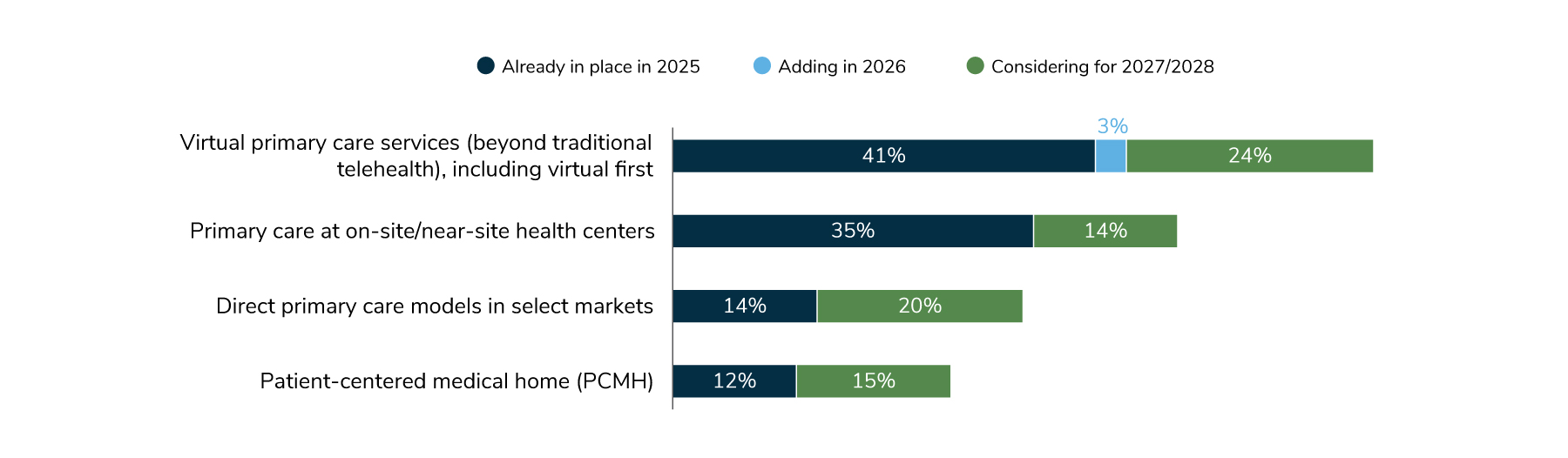
Source: From 2026 Employer Health Care Strategy Survey. Business Group on Health. August 2025.
Primary Care Focused Accountable Care Organizations (ACOs)
ACOs led by primary care groups have seen greater success in controlling total cost of care in Medicare compared to their counterparts that are run by hospitals. Hospital-led ACOs often generate most of their revenue through inpatient admissions reimbursed through FFS, whereas a primary care group operating under a risk contract can increase their revenue by keeping people healthy and out of the hospital.
Direct Primary Care (DPC)
Practices in the DPC model do not accept FFS payments for the DPC services they provide as part of the arrangement. Instead, they are paid a fixed, periodic fee per attributed member to manage the health of their total population. What’s unique about DPC practices is that neither the physicians nor the practices themselves make money for driving utilization. This gives providers the freedom to innovate in how they address population health, because when they keep people healthy and out of more expensive settings of care, everyone “wins” financially. Additionally, legislative changes enacted through the One Big Beautiful Bill Act (OBBBA) have opened up the DPC space for greater employer investment/funding by clarifying that individuals enrolled in certain DPC arrangements remain eligible to contribute to health savings accounts (HSAs) and use HSA funds to pay for DPC fees. While initial agency guidance seemed to potentially narrow some of the benefits from the OBBBA, the Treasury Department is reviewing comments and may take action and hopefully will broaden the allowance to help drive innovation and adoption. For more detailed information on these legislative changes and related implications for employer-sponsored primary care arrangements, see the Business Group’s resource, IRS Issues Guidance on HDHP/Telehealth, Direct Primary Care Provisions of One Big Beautiful Bill Act.
Enhanced On-Site or Near-Site Clinics Incorporating Primary Care

Comprehensive Primary Care Delivered Virtually?
Many brick-and-mortar primary care groups are succeeding in improving access and convenience by encouraging patients to access care virtually when clinically appropriate and it aligns with their preferences. Going further, several established and newer players in the virtual health market are also offering models that offer comprehensive, longitudinal primary care that can serve as a member’s primary care “home” rather than using virtual health as a supplement to bricks-and-mortar care. This approach can dramatically increase ease of access, and when paired with remote monitoring and at-home diagnostic testing, it can provide a significant portion of what someone needs from primary care.
Since on-site and near-site clinics are no longer limited to occupational health, many employers are working with provider partners to increase the scope of services offered in these facilities, including holistic primary care, pharmacy, and mental health. According to the Business Group’s 2026 Employer Health Care Strategy Survey, 35% of respondents are offering primary care at on-site/near-site health centers in 2025—with an additional 14% considering doing so in 2027/2028 (Figure 1). The convenience of having a full suite of primary care services at the worksite saves employees time and increases access to services like mental health care and preventive tests, which are often underutilized. Providing these services affords employers a greater ability to drive utilization of high-performing specialty care through virtual referral networks.
As virtual health continues to expand in the primary care space and more broadly across the health care delivery system, there will be opportunities, barriers and risks that need to be examined and addressed. For further insight on this issue, see Shaping the Future of Virtual Health: Creating Agile Solutions.
Related Resources
- Taking Action on Primary Care: A Business Group on Health Viewpoint
- Value-based Primary Care
- IRS Issues Guidance on HDHP/Telehealth, Direct Primary Care Provisions of One Big Beautiful Bill Act
- On-Site and Near-Site Clinics: Maximizing Value as Needs Evolve
- Powering Engagement and Improving Outcomes Through Effective Navigation
- Solving the Lost In-network Challenge
More Topics
Resource
 Primary Care
Value-based Care
Primary Care
Value-based Care